
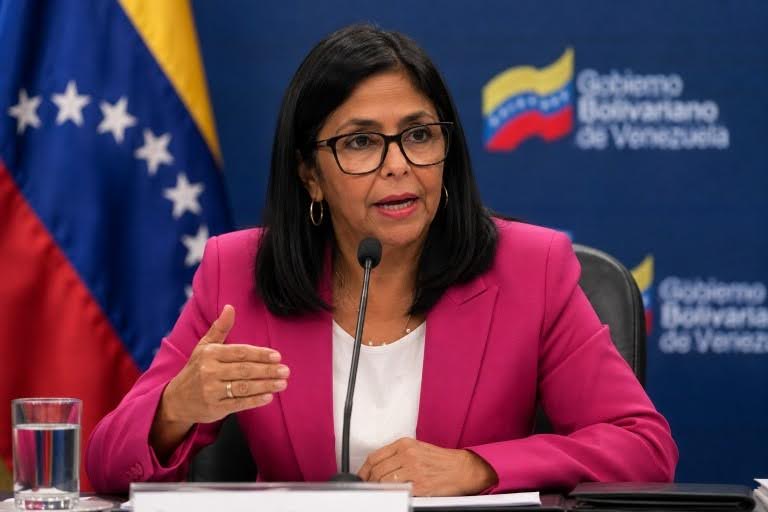
Venezuela’s interim president, Delcy Rodríguez, has staunchly defended an energy agreement with the United States that has sparked significant controversy within her country. Despite harsh criticism claiming that the deal compromises Venezuela’s national resources, Rodríguez assured that the nation maintains full ownership and sovereignty over its oil reserves. After taking office earlier this year following the removal of Maduro in a US-led operation, Rodríguez addressed the public to highlight the potential advantages of the agreement, which she believes could yield over $209 billion in revenue and position Venezuela as a leading energy producer.
Rodríguez emphasized that while Venezuela’s underground oil reserves are vast, they hold little value without the necessary investment, technology, and infrastructure to translate them into tangible economic benefits for its citizens. The agreement, reportedly negotiated in secrecy over several months, reportedly grants the US significant control over a large portion of Venezuela’s crude reserves, which are recognized as the largest proven reserves globally, surpassing those of Saudi Arabia and Iran. Rodríguez mentioned that the deal involves 17 strategic oilfields with a production goal of over 1.5 million barrels per day.
The announcement has ignited a wave of backlash from both opposition figures and members of Rodríguez’s own political faction. Critics have labeled the agreement as a resource grab, with a former state oil executive condemning it as a betrayal of national sovereignty, pointing out that such a transfer of reserves is unprecedented in Venezuela’s history. In response, demonstrators took to the streets of Caracas, protesting against what they perceive as foreign encroachment on national resources. This sentiment was echoed on social media, where users mocked the deal, suggesting a rebranding of the state oil company.
This shift marks a notable reversal for Rodríguez and her political movement, which has traditionally opposed foreign control over Venezuela’s natural resources. Rodríguez herself had previously cautioned against similar arrangements in past public statements. Opposition leaders have also voiced concerns that the agreement could hinder efforts to re-establish democratic elections in Venezuela, questioning the timing of future electoral processes. Critics argue that sustainable economic progress hinges on transparent governance and free elections, warning that without these, the agreement could be built on an unstable foundation.